
What is a Man?
By Vance Hoppe
There is a recent flurry of activity that has drawn this question to the forefront of many conversations. There are countless ads, podcasts, and even political speeches directed to the connotation of creating masculine men. Feminism has failed to define “What is a Woman,” as so eloquently documented by Matt Walsh. Sadly, those more conservative voices have failed equally in defining, “What is a Man?” Think about this, when was it that you truly became a man? Was it at a certain age, your first kill, your first kiss? When does the boy realize he is no longer a child, but a man?
There is no shortage of people ready to provide their advice. They may applaud physical strength or ability, intellectual prowess, educational or occupational affluence as validation for the stature of a man. As a matter of fact, there are many who depend on platform or applause for their man card. It is a dangerous thing to entrust our sons or ourselves to men who do not have the callouses on their hands to prove their experience. You see this among many influencers today. Their contributions are philosophical alone, they give the appearance of building online, while nothing real gets done. Even among those who recognize this, they hope to secure their identity with “manly” hobbies like hunting, weightlifting, or BJJ. More recently, there is a growing number demanding we legislate their manhood into existence by crushing DEI and feminism, returning men to their rightful place of authority. It is not my present intention to evaluate these attempts, but to highlight the shortfall this has produced in defining masculinity. Some insist on a forced paradigm. It can be seen in the fact physically weak men do not like physically strong women, just as intellectually dumb men don’t care for more astute women. It isn’t much different than a man preferring a woman shorter or a woman preferring a man taller. The point that needs to be made is this: masculinity depends on no one to become masculine. It is not a mere relation between sexes.
Masculinity bears an integrity that remains when there is no audience. It operates with honesty of circumstance despite the outcome. Ironically, the true man has the situational awareness to even evaluate his own shortfalls. How, then, do we teach this to our sons? As I tell my boys, a man is not made in a day. You lay aside the ways of a child, little by little, and pick up the ways of a man, one by one, so that one day reality doesn’t slap you in the face. It is my imperfect rendering of Paul’s words in 1 Corinthians 13:11:
When I was a child, I spoke like a child, I thought like a child, I reasoned like a child. When I became a man, I gave up my childish ways.
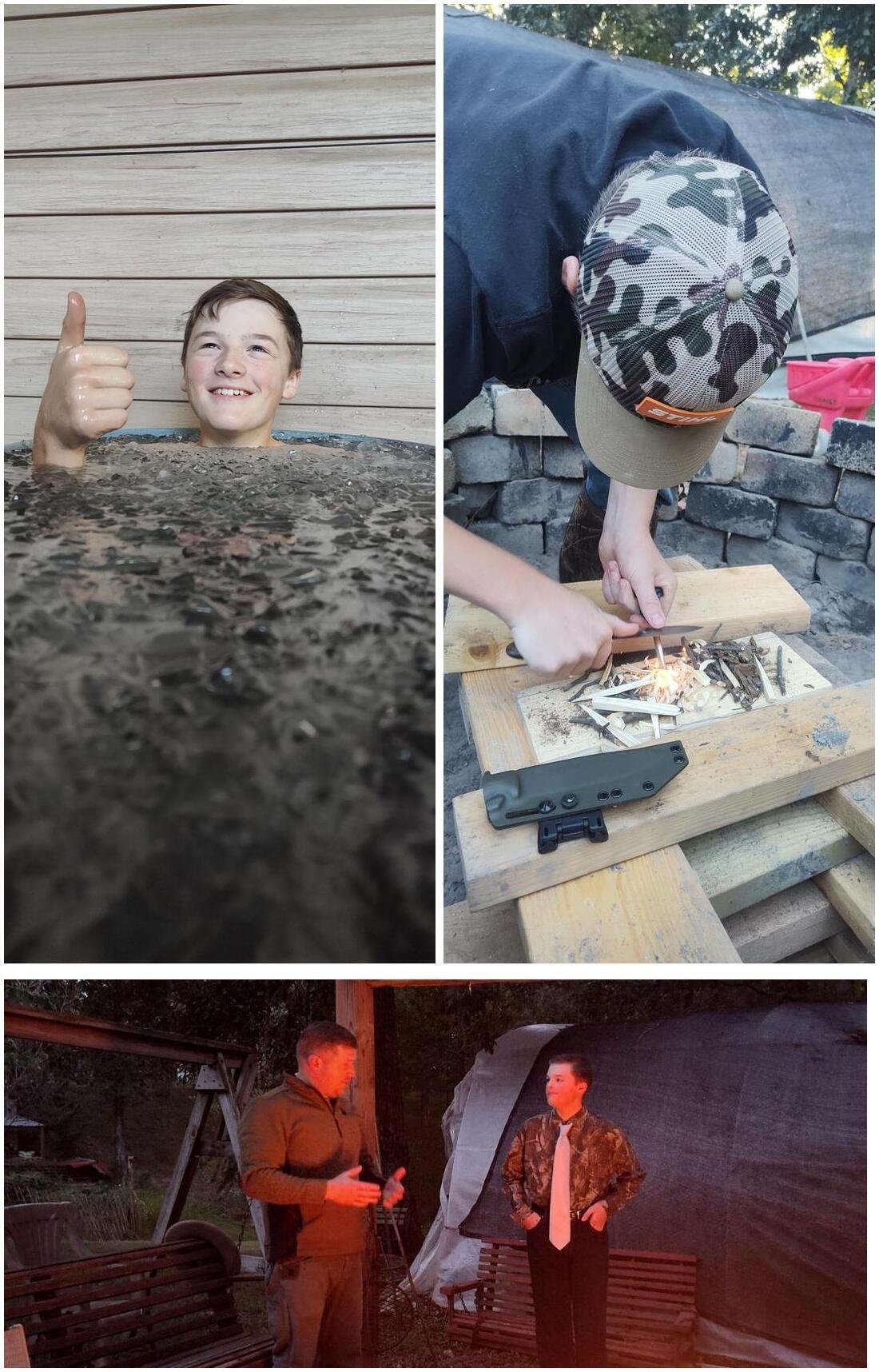
It is good to give clear markers to our sons, marking out this process. In our attempt to do so, I put my sons through a right of passage of sorts, at the age of fourteen. They will hook a trailer up by themselves, pull it out and back it into the barn without help, they must start a fire without a lighter, sit in an ice bath for greater than one minute (though everyone loves to go longer), be able to tie a neck tie, and recite a poem of their choosing with prose. Obviously, more could be added, some of these are perhaps unnecessary, and none of these demonstrate the meaning of absolute manhood. The point is that they commit to learn new things, do hard things, prepare for what they can, and learn to adapt where they must. Each of them gets this speech wherein they understand they cannot have the experience time has not granted them and their capabilities are not what they shall be, but they must shift in the way they view and respect themselves as men. This brings a new level of responsibility and added accountability. A boy learns these things for himself as he matures, a man provides and employs them for others. Manhood is not learned through a screen or at a conference. It is forged through blood, sweat, and tears in relationship with men who desire their sons to be greater than themselves. A man is made such through discipleship and sacrifice. There can be no substitute and no better example than Christ. Masculine success, from the Christian perspective, does not require government coercion, influential platforms, or successful side hustles. It requires all of life submitted to God, quietly, faithfully, sacrificially. Even in the face of apparent loss, this man will succeed and fulfill his calling in the kingdom of God.